
Summary:
Sending large files to China can be challenging due to restrictions on Western cloud services like WeTransfer and Dropbox.. Solutions like NiHao Cloud, FileCloud, and Weiyun provide varying degrees of functionality, but Sinosend stands out by transforming file transfers into branded digital sales rooms, enhancing business interactions and trust.
Skip reading: Send a file to your vendor/supplier here: Send 3GB and get notified when they get it
Doing business with China often means sending large files — product specs, contracts, design files, or marketing assets. But if you’ve ever tried to send something important using the usual heroes like WeTransfer or Dropbox, you’ve probably run into a frustrating reality: they don’t work reliably in Mainland China. Thanks to the Great Firewall, many Western cloud services are blocked or throttled. Even if you manage to send a file, your factory or partner in China may never receive it, or worse, the file may be removed without notice.
Most people default to email when sending files, but that’s risky if you’re working with partners in China. You never really know if the attachment will make it through, whether it gets caught in spam filters, or if the recipient even opens it. Large files often bounce back, and once you hit “send,” you lose visibility.
Some companies fall back on WeChat or QQ for file sharing. While these apps are ubiquitous in China, they’re not professional file transfer tools. Both parties need the app, file sizes are limited, and shared files often disappear after a short time. For serious business use, you need something more reliable.
File Transfer Tools That Work in China
Here are some of the best options for transferring files into and out of China, along with their pros and cons.
OneDrive / SharePoint
Microsoft’s OneDrive and SharePoint technically work, but adoption in China is limited. Many local partners don’t use these services, the Chinese interface is incomplete, and licensing costs are high. For simple file sharing, they can feel overly complex.
NiHao Cloud
NiHao Cloud is designed specifically for cross‑border collaboration with China. It doesn’t require a VPN and offers secure file sharing between international teams.
Pros: Easy access in China, no VPN needed, supports global sync, encryption, and business cloud features.
Cons: Smaller ecosystem compared to global giants, fewer integrations, and pricing may be higher than consumer‑grade tools.
FileCloud
FileCloud is a secure content collaboration platform with strong compliance and governance features.
Pros: Robust security, granular sharing controls, compliance features (GDPR, HIPAA), and enterprise‑grade scalability.
Cons: Higher cost per user, can be complex to set up, and may be overkill for small businesses just looking to send files.
WeChat and QQ
These are the default tools for many Chinese users.
Pros: Everyone in China has them, quick for small files.
Cons: Not professional, limited file size, files expire, and no branding or tracking.
Weiyun
Weiyun is Tencent’s cloud storage service. It offers up to 10TB of free storage and integrates with Tencent’s ecosystem.
Pros: Huge storage, reliable inside China, mobile apps available.
Cons: Limited English support, not designed for international business users, and sharing with overseas partners can be clunky.
✨ Sinosend
Finally, there’s Sinosend — our platform built as a WeTransfer alternative for Asia.
With Sinosend, you don’t just send a file — you create a professional, branded experience. Files are delivered from your own domain, so they look trustworthy and on‑brand. You can see when recipients open them, where they’re accessed from, and whether they’ve been downloaded. That means no more guessing if your proposal got lost in someone’s inbox.
But the real value isn’t just in sending files — it’s in what those files can do for your business. With Sinosend, every transfer can become a digital sales room:
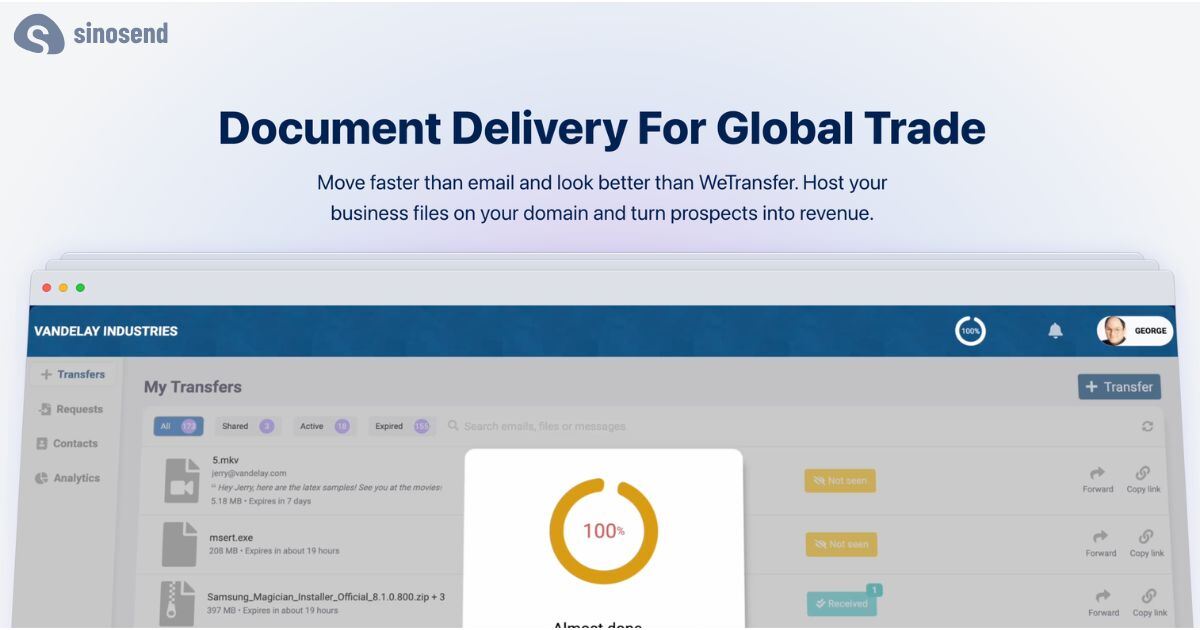
• A space where your clients can return to view updated versions of your proposals or product sheets.
• A branded environment that reflects your company, not a third‑party service.
• A tool that helps you close more deals at trade shows or during international negotiations, because prospects leave with a professional portal they can revisit, not just a one‑off email attachment.
Instead of thinking of file transfer as a utility, Sinosend reframes it as a sales advantage. You’re not just moving data — you’re building trust, reinforcing your brand, and giving clients a reason to take the next step with you.
This shift — from “sending files” to “creating digital sales rooms” — is what sets Sinosend apart, and it’s exactly what I’ll explore in my next post: Why You Need a Digital Sales Room.
In Summary with Sinosend, you can:
• Choose where your data is stored (including Hong Kong for data residency).
• Use your own custom domain and remove all branding.
• Send files for free, or upgrade for advanced features like dashboards, analytics, and multilingual support (5 languages).
• Create a digital sales room: a branded space where clients can access updated files, proposals, and marketing assets — perfect for trade shows or ongoing client relationships.
Unlike chat apps or generic cloud storage, Sinosend is designed to help you look professional, build trust, and keep control over your data. Learn more about Sinosend Edge Delivery here
Final Thoughts
If you’re working with partners, factories, or clients in China, relying on blocked or unreliable tools is a recipe for frustration. From NiHao Cloud to Weiyun, there are several options — but if you want a professional, branded, and Asia‑focused solution, Sinosend is built for exactly that.