
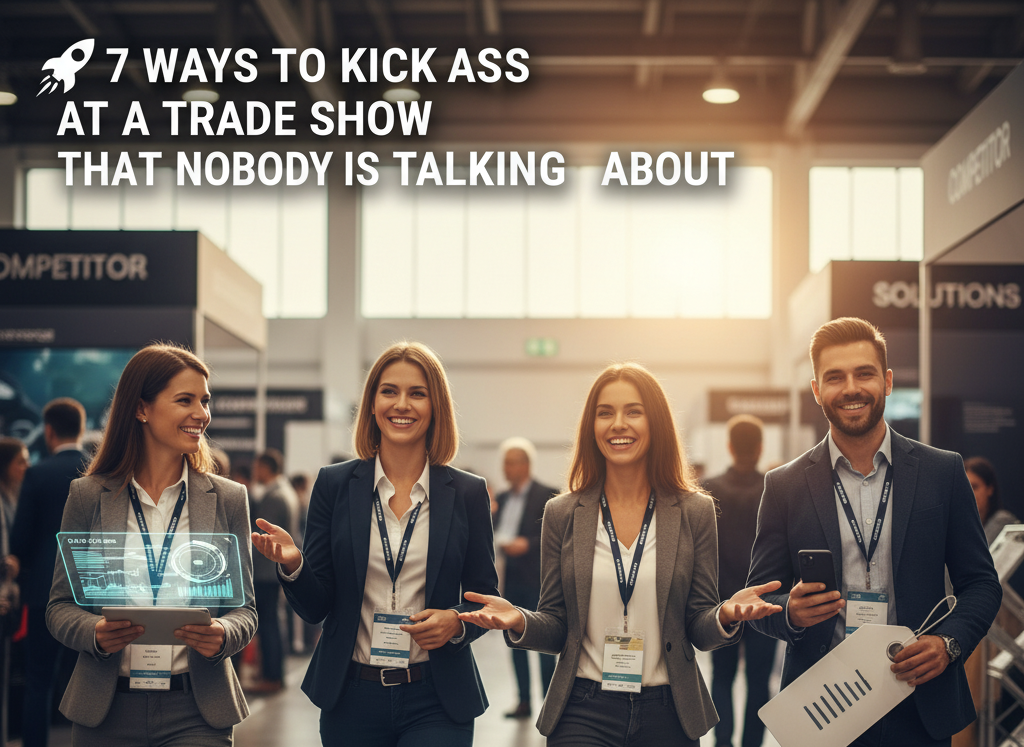
I’ve been watching people crash and burn for 20 years at trade shows. These tips are what kept our company afloat and brought us results. We were a small, lean team trading in textiles, often myself going solo. After years, I ditched what I thought was "right" and found these provided the ROI that we needed. Here are 7 tips plus a bonus one we discovered after all these years. This is the un-advice you actually need; this is how you become the highlight of the entire show, well, at least your aisle.
You've got the product, the dazzling booth backdrop, and a stack of business cards. But let's be honest: The trade show floor is a brutal, fluorescent-lit arena where most are instantly forgotten. You, the newcomer, are about to be thrown into the deep end. You need more than just a firm handshake, lousy swag and a cheesy line.
This isn't a numbers game – it's a memory game. What's more valuable: a stack of 300 business cards from people who won't recall your name, or a handful of high-converting 'whales' who connected with you?
🔑 My Foundational Four Secrets
If you’re the lone wolf exhibitor or managing a small pack, these four tips are your non-negotiables for breaking the ice and reading the room like a pro.
1. Leave the booth
This one is a total mind game, and it works. When traffic slows, leave the booth. Step aside and do perimeter patrol. Stand a few meters away, or even pop into the next aisle and monitor from afar. Why? Because an empty booth without an aggressively grinning salesperson is psychologically less intimidating. You’ll find some genuine buyers, the introverts, or the cautious ones, will actually stop and look. They are examining your product, not just avoiding your eyes.
The Move: Give them a moment. If they stick around for more than ten seconds, run in (don't walk) and say something funny—something self-deprecating or witty that breaks the tension.
2. Ditch the Notebook, be handsfree.
Nothing screams "transaction" like a calculator. You are not an accountant; your new title at the show is "solution-oriented expert". I know it sounds cool and cheesy but roll with it.
The Move: Pocket the gadgets. Talk to them like they’re a friend who just walked into your kitchen. Use open body language—palms facing out, expansive gestures—to project trust and approachability. This signals, "I have nothing to hide, and I’m ready to solve your problem, not just hit a quota." The numbers talk comes later, after the trust is built.
3. The Price Tag Test
Tag some of your products, you will find buyers often like to touch and turn the tag around hoping they will see a price, when they do, you know they are interested, this shows intent.
The Move: Use a prominent tag that makes them work a tiny bit. The physical act of a buyer picking up your product and seeking a price is the strongest, non-verbal cue you will get all day. It’s the difference between a browser and a buyer. When you see the price tag turn, you know they've qualified themselves, and your follow-up line can skip straight to business.
4. Act like the Aisle is part of your booth space.
On their way out, walk them out. You'd do the same at home wouldn't you? Keep the conversation going a meter outside your booth, this will draw other people to your aisle.
People are sheep. They are drawn to excitement and human activity. A busy booth is a magnet.
The Move: As the conversation concludes, walk with your new friend (who you talked to personally!) a meter or so into the main aisle. The visual of two people having an engaging chat just outside your space makes your corner of the world look like the place to be. It literally re-directs foot traffic down your aisle.
💥 The Next-Level Three: Go Beyond the Booth
Okay, you’ve mastered the core. Now, let’s go completely outside the box.
5. Embrace the Enemy
Every attendee is walking past your competitor's booth, you see them from afar. You hate it when they stop there. Lets reframe that emotion, and use that to your advantage by reframing the interaction before they even get to you.
The Move: When an attendee eventually stops at your space, instead of a generic opener, try: "Hey, welcome! Been looking at any other exciting widgets today? Any of our competitors stand out?" or simply "Have you seen anything good at the show?"
If they mention a competitor, don't trash them. Instead, say: "Ah, [Competitor Name], they're fantastic at X. We actually focus more on Y, which works wonders for [The specific, unique customer pain point you solve]. Let me show you why that difference matters."
Why it Works: It’s disarming. You're confident enough to acknowledge the competition, which builds massive trust. You immediately pivot the conversation from a general pitch to your unique selling proposition (USP), cutting through the noise and positioning you as a knowledgeable, secure expert, not just another desperate vendor.
6. Go Anti-Swag
For years, we wasted time and money buying those little tchotchkes—cheap pens, notebooks, and candy—from Taobao or AliExpress. We did it only to satisfy some outdated notion of exhibiting, not because they provided any real value. The truth? Real buyers don't collect junk. All that "swag" was dumpster trash that distracted us and wasted time attracting the wrong kind of browser.
Go Anti-Swag.
The Move: Instead of generic items, offer a highly specific, premium piece of digital content—think a proprietary industry cheat sheet, a custom ROI calculator, or a 10-point checklist for a pain point only your product solves.
When you finish your chat, say: "I'm not going to give you a brochure you'll loose, Instead, I’ve got a 3-minute video that shows exactly how we save clients like you $50k a year. If I send it to your work email right now, can I trust you to watch it on your flight home?"
Why it Works: It shifts the value exchange. You’re asking for their best email (a quality lead) in return for a targeted, non-generic asset. Crucially, you’ve secured a micro-commitment from them ("Can I trust you to watch it?") that drastically increases the likelihood of a high-quality follow-up. You can use Sinosend to send your digital assets along with a voice memo, perfect for follow-ups.
7. Instant Voice Recap ( I love this one )
Most exhibitors shake hands and hope for the best. But you're not most exhibitors now. You're going to do something that immediately sets you apart, summarizes the value, and gets a verbal commitment, all while demonstrating you're a serious player. This isn't about sending them a voicemail later; it's about creating a memorable record together, right then and there.
The Move: As your conversation with a promising lead is about to wrap up, say: "Before you go, I just need to take a minute to quickly summarize our chat, I find it helps both of us lock in the key points." If your not a boss or even if you are, add in "My boss doesn't believe I'm working hard enough", so this is proof!"
Then, pull out your phone—not to scan their badge, but to open your voice recorder/memo app. With them listening, briefly recap the core points you discussed: "Okay, so, I'm so happy to have met [Prospect's Name], just to make sure I've got this right: you're looking for [specific solution/product sku], mainly to solve [key pain point], and the most important thing for you is [their top priority]. Does that sound about right?"
Let them nod, affirm, or even add a detail. Crucially, when they play back that message later (or if you send it to them), they'll hear their own voice agreeing or adding to the summary.
Why it Works:
- Instant Confirmation & Alignment: You immediately confirm understanding, ensuring you're both on the same page before they walk away. This drastically reduces miscommunication.
- Builds Trust & Professionalism: It shows you're meticulous, a fantastic listener, and value their time and input. You're not just selling; you're documenting.
- Creates a "Shared Memory": This isn't just your recap; it's a verbal contract created with them. Hearing their own voice validates the agreement in a powerful way.
- A "Player" Move: It's unconventional and confident. It demonstrates you're organized, resourceful, and dedicated to their specific needs.
- Even if you don't have their number on hand to send it immediately, the act of recording it in front of them is enough to make an impact. It shows you're serious.
BONUS: The "Standing Snack" (Be Human, Not Hibernating)
Look, I get it. You're exhausted. Your feet are screaming, and the thought of a quiet moment with a sandwich is pure bliss. But listen: nothing screams "lazy fatso" like seeing an exhibitor slumped in a chair, shoveling food.
The Move: If you need to eat, eat standing up. Position yourself at the corner of your booth. You're still visible, still approachable. You're showing that even when fueling up, you're present and ready. I'm not saying eat a bowl of sloppy spaghetti, but here’s the kicker: if your salad looks good, or that power bar sparks curiosity, it could even become an engaging conversation starter. "Ooh, what's that you're eating?" suddenly gives you an opening. It’s only 20 minutes, it will change your day a little, and it shows you’re human—a human who is still on the job.
Why it Works: It maintains your energy and professional image, even during a necessary break. It subtly communicates dedication and accessibility, turning a mundane act into another opportunity for connection.
🏆 Final Thoughts: You Got This
Trade shows are a marathon of human interaction, not a sprint of sales pitches. Be the authentic, friendly, slightly cheeky expert who has the confidence to step out of the crowd, the wisdom to listen to non-verbal cues, and the strategy to turn a casual encounter into a quality conversation. Ditch the clipboard, trust your gut, and go make some genuine personal connections. You may not land a deal this year, but when you return to the show floor, the same buyers who walk it last, will great you with a grin and a handshake saying "I remember this gal/guy".